Government Housing Assistance Programs: Complete Guide
30% to 39%
$24 billion
Last year in CA in homelessness funds was distributed to local cities, counties, and nonprofits.
of transgender and nonbinary individuals will experience homelessness or housing instability at some point in their lives. This is nearly eight times higher than the rate for the general U.S. population
________________________________________
Government Housing Assistance Programs: Complete Guide
Overview of Major Housing Assistance Programs
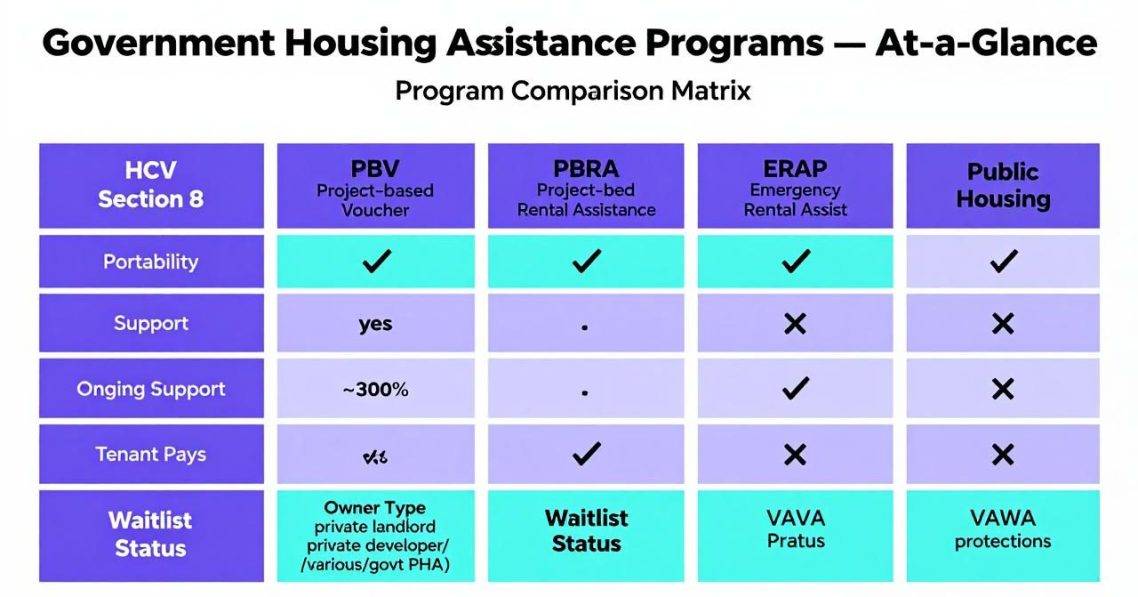
There are several distinct federal housing assistance programs, each with different structures, tenant rights, and landlord responsibilities. Below is a clear breakdown:
1. HOUSING CHOICE VOUCHER (HCV/SECTION 8 TENANT-BASED)
What It Is The Housing Choice Voucher Program helps low-income families, elderly persons, veterans, and disabled individuals afford housing in the private market. The voucher follows the tenant, not the property. Approximately 2,000 local Public Housing Agencies (PHAs) administer this program with HUD funding.
How It Works
- Families pay approximately 30% of their adjusted monthly income toward rent
- PHA pays the difference between the family contribution and the lesser of:
- The actual rent charged, OR
- The PHA's Payment Standard
- Families can choose any qualifying housing unit (single-family homes, townhouses, apartments)
Tenant Rights
- Right to select any housing unit meeting program requirements
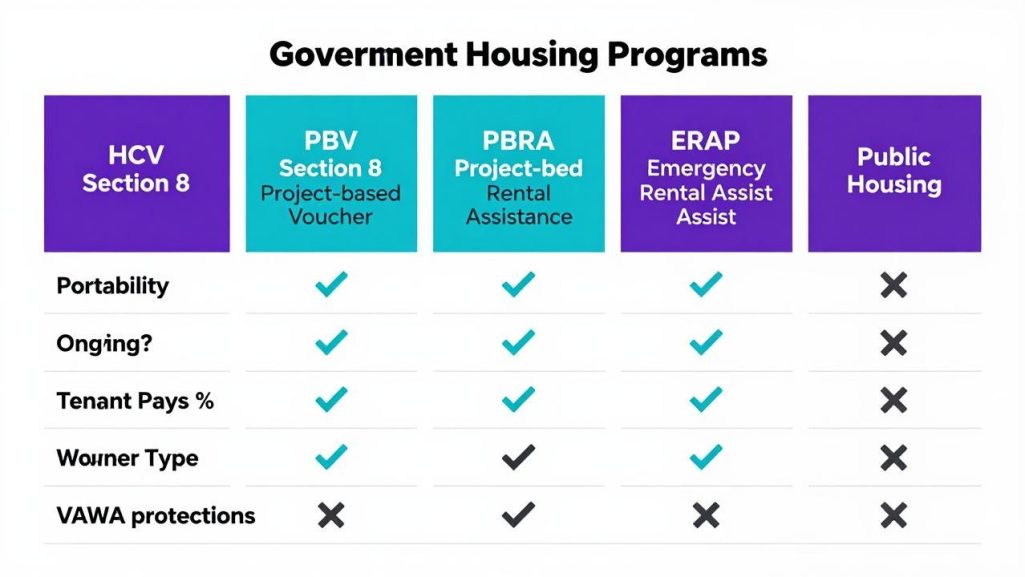
- Portability - ability to move and take assistance elsewhere
- Fair housing protection from discrimination
- Right to housing that meets HUD Housing Quality Standards (HQS)
- Due process hearings before voucher termination
- Ability to request reasonable accommodations for disabilities
- Protection under VAWA from eviction due to domestic violence
Tenant Responsibilities
- Pay family portion of rent on time
- Maintain the unit in good condition
- Report changes in income or household composition promptly
- Attend all required briefings and recertifications
- Not commit serious lease violations
- Use the unit as primary residence
Landlord Responsibilities
- Maintain HQS-compliant housing conditions
- Charge rent that is "reasonable" compared to comparable unassisted units
- Provide all agreed-upon services and utilities
- Cannot discriminate based on source of income (where state/local law prohibits)
- Participate in PHA inspections
- Sign HAP contract and lease terms
2. PROJECT-BASED VOUCHERS (PBV)
What It Is Project-Based Vouchers attach rental assistance to specific units through contracts between PHAs and property owners. Up to 20% of a PHA's HCV portfolio can be allocated to PBVs, with an additional 10% allowed for enhanced purposes (veterans, homelessness prevention, supportive housing).
Key Differences from Tenant-Based Vouchers
- Assistance remains with the UNIT, not the tenant
- Tenants cannot take the subsidy to another property
- Long-term affordable housing preservation tool
Tenant Rights
- Same HQS requirements as HCV
- Rent reasonableness determinations apply
- Relocation assistance if PBV contract terminates
- VAWA protections apply fully
- Grievance hearing processes available
- Right to remain if qualified after initial placement
Tenant Responsibilities
- Meet income eligibility requirements at application
- Pay 30% of adjusted income toward rent
- Comply with standard lease obligations
- Keep unit in acceptable condition
- Notify PHA of household changes
Owner Responsibilities (per 24 CFR §983.209)
- Maintain all contract units in good condition per HQS
- Provide all services, maintenance, equipment, and utilities agreed upon
- Certify no familial relationships with tenants (unless approved accommodation)
- Charge rent not exceeding comparable unassisted units
- Receive NO compensation beyond HAP payments and tenant rent share
- Implement VAWA protections immediately
3. PROJECT-BASED RENTAL ASSISTANCE (PBRA)
What It Is Distinct from PBV, PBRA involves direct contracts between property owners and HUD (not local PHAs). This preserves long-term affordable housing stock across various Section 8 programs dating back to the 1970s.
Covered Program Types
- Section 8 Moderate Rehabilitation
- Single Room Occupancy (SRO)
- Section 202 Supportive Housing for Elderly
- Section 811 Housing for Persons with Disabilities
- Rental Assistance Program (RAP)
- Flexible Subsidy Program
Rights & Responsibilities
Tenants have similar protections to HCV/PBV recipients:
- Income-based rent calculation (~30%)
- HQS compliance required
- VAWA protections apply
- Lease terms govern relationship
- Transfer rights vary by project
4. EMERGENCY RENTAL ASSISTANCE PROGRAM (ERAP)
What It Is Created through Consolidated Appropriations Act legislation, ERAP provides one-time cash assistance for eligible households facing financial hardship. Unlike ongoing subsidies, it's a single-payment intervention.
Purpose
- Pay past-due rent
- Cover utility arrears
- Assist with move-in costs
- Prevent imminent eviction/homelessness
Limitations
- Time-limited assistance only
- Does NOT create ongoing tenancy rights
- Amount varies by jurisdiction
- Must document financial hardship/income loss
- Funds go directly to landlords/utilities (not tenants)
5. PUBLIC HOUSING
What It Is Government-owned and operated housing developments managed by local PHAs. Completely separate from Section 8 programs.
Eligibility
Very low-income families (typically below 50% Area Median Income)
Characteristics
- Rent calculated at 30% of adjusted income
- Units owned by PHA
- Waitlists often lengthy
- Specific location requirements
- Different application process than vouchers
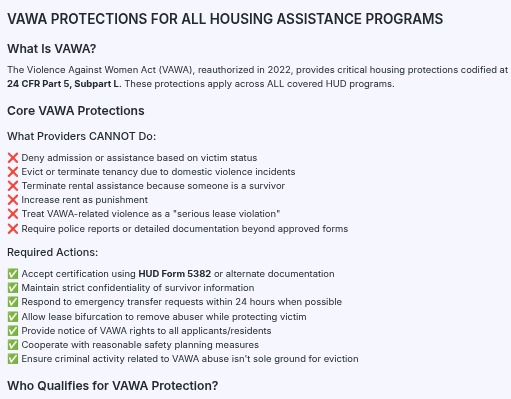
VAWA PROTECTIONS FOR ALL HOUSING ASSISTANCE PROGRAMS
What Is VAWA?
The Violence Against Women Act (VAWA), reauthorized
in 2022, provides critical housing protections codified at 2
4 CFR Part 5, Subpart L. These protections apply across
ALL covered HUD programs.
Who Qualifies for VAWA Protection?
Survivors of:
- Domestic violence
- Dating violence
- Sexual assault
- Stalking
Protection extends to affiliated household members.
Helpful Resources
- Find Local PHA: https://www.hud.gov/offices/pih/phc/contacts/index.cfm
- Complaint Process: File VAWA/Fair Housing complaint at https://www.hud.gov/hud-partners/fair-housing-vawa
- National Low Income Housing Coalition: https://nlihc.org (advocacy + policy updates)
- Center on Budget and Policy Priorities: https://www.cbpp.org/research/housing (research data)
Disclaimer: This information is compiled from official HUD sources and regulations as of 2026. Individual Public Housing Agencies may have local administrative variations. Always confirm details with your local PHA or consult official HUD documentation for current guidance. For legal advice regarding housing rights, contact a qualified attorney or legal aid organization in your area.
Would you like me to refine any particular section, add more detail about specific programs, or adjust the formatting for your website platform?